Where Does Burger King Get Its Beef?
The world's biggest supplier of burgers sourced meat from a farmer in the Amazon who had been found guilty of using deforested country, say reports, even as new figures reveal the beef industry's deforestation risks.
Marfrig, a Brazilian meat company that has supplied McDonald'southward, Burger Male monarch and other fast-food chains around the world, bought cattle from a farm that had been using deforested land earlier this year, according to a joint investigation by Repórter Brasil and the Bureau of Investigative Journalism.
The company said it was misled by a government document that cleared the farm of deforestation, and it has since ended the association. Marfrig has recently launched an environment "transition bond" to tap into the growing sustainable investment market.
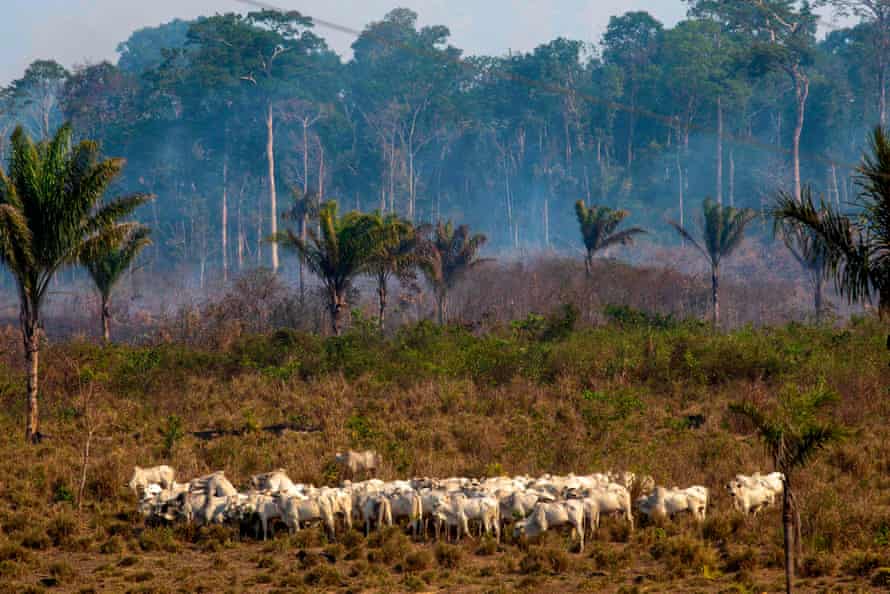
In January, inspectors from Ibama, Brazil'due south environmental watchdog, found cattle from Limeira Ranch grazing on illegally deforested country inside a protected region, the Triunfo practice Xingu environmental protection area in Pará state. The region has been devastated by forest fires this year.
The office of the subcontract where the cattle were found had been placed under an official embargo – which prohibits grazing – three years before, due to illegal felling. Embargos are imposed for ecology violations and serve both as a penalization and protective measure to allow land to recover.
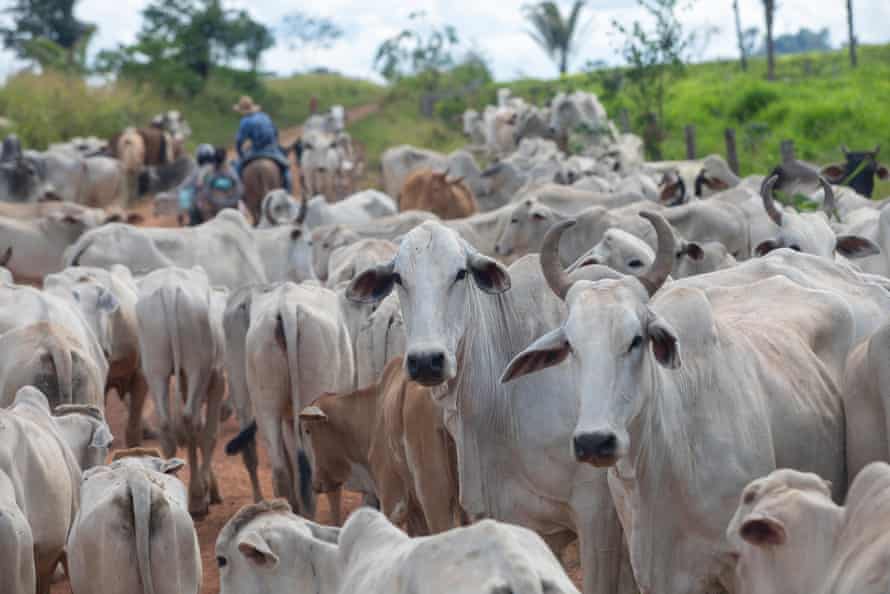
For breaking the embargo, the ranch was fined 1.19m reais (£236,000) this year. Despite this, documents obtained by Repórter Brasil show that 144 cattle from Limeira Ranch were subsequently supplied to a Marfrig slaughterhouse in Tucumã, in Pará. The company also bought cattle from the ranch on multiple occasions in late 2018. There is no evidence that the cattle Marfrig purchased were themselves raised on illegally deforested country.
Marfrig told the Guardian: "On the date of purchase, February 16, 2019, Marfrig'south geo-monitoring platform collected all available information near the supplier … At that date … there was no record of non-compliance. It was not on the Ibama embargoed producers list, in that location was no satellite detection of deforestation in the surface area and the rancher was not on the official list of companies using slave-like labor.
"Ibama issued a negative certificate assuring that on that appointment … nothing was against the supplier. And that's the only way companies – not only Marfrig – can look for official data in real time. From the moment the official inclusion information was made available by Ibama, the supplier (and and then in any and all cases) was automatically and immediately blocked. This ways that, since then, rancher Adriano José de Mattos and Fazenda Limeira cannot supply Marfrig." Marfrig supplied the Ibama certificate clearing the ranch as part of their reply.
The Agency has established, using merchandise data and shipping records, the extent of the links between Brazilian meat companies and the UK. Nearly £1bn worth of beef supplied by 3 of the meat giants – Marfrig, JBS and Minerva and their subsidiaries – was straight imported to the UK in the past 5 years.
Much of this supplied major UK supermarkets, as well equally wholesalers and independent nutrient companies.
Meanwhile new figures released past Trase, a supply-chain initiative run by the Stockholm Surround Institute and NGO Global Canopy, delineate the deforestation risks in the export supply chains of 3 of Brazil'south major beef companies, including Marfrig. The Trase inquiry mapped supply chains for beef from international markets back through community and slaughterhouses to the municipalities where cattle were raised, using community, agricultural, and sanitary inspection data.
Having traced the cattle back to their original municipalities, Trase cantankerous-referenced government figures on cattle numbers with deforestation data and official data on new pastures to calculate a deforestation "risk" – presented as an expanse in sq km – associated with companies and specific international markets.
The analysis includes data on "indirect" suppliers, which are often intermediate farms that don't sell directly to abattoirs, but supply other farms that may truck cattle to slaughter.
According to Trase's calculations, Marfrig'southward beef exports come from farms linked to up to 100 sq km of deforestation risk a year in Brazil. Trase also calculated figures for JBS, the world's biggest meat company, and Minerva Foods, another big global supplier of Brazilian beef. JBS beef exports have been linked to farms involved in upwards to 300 sq km of deforestation risk per yr, and Minerva Foods linked to farms involved in 100 sq km of risk, co-ordinate to the inquiry.
Marfrig said: "It would exist a mistake to conclude from Trase data that there is a link between the cattle purchased by Marfrig and deforestation in the region. Precisely because information technology understands that at that place is a risk and that Trase information provides relevant services for the preservation of biomes, Marfrig developed and implemented its geo-monitoring platform. This system is audited past an independent third party – Norwegian DNV GL. Using this platform and analysing Trase information, Marfrig substantially mitigates the risk of acquiring animals from deforestation – using, since 2009, the zero deforestation criterion for the Amazon biome."
Minerva said: "Sustainability forms 1 of the fundamental pillars of Minerva Foods, at its core to feed the world, conserve the planet and enhance human value … 100% of Minerva's purchases come up from zero-deforestation areas in the Amazon biome. Overlapping our suppliers' ranch map with deforestation polygons, indigenous lands and environmental protection areas, our sustainability department blocks any supplier that are not compliant with any of the criteria, which finer means that Minerva can't buy whatever animals coming from these suppliers."
JBS said: "JBS has an unwavering commitment to combat, discourage and eliminate deforestation in the Amazon region … For most a decade, nosotros accept monitored our supply concatenation with satellite technology, geo-referenced farm data and official government records to ensure compliance with our stringent responsible sourcing policies … The most contempo inspect in 2018, conducted by DNV GL, a global quality assurance and certification company based in Norway, confirmed that 100% of our cattle purchases were in compliance with our responsible sourcing policies."
Burger King told us: "Our goal is to eliminate deforestation within our global supply chain, and we are working toward this." They said that all their suppliers were required to comply with their sustainability and wood protection policies.
McDonald'south said information technology aimed to eliminate deforestation from its global supply chains past 2030 and that it had "made a commitment not to purchase raw material from any farm in the Amazon … linked with deforestation".
This July Marfrig launched a $500m "transition" bond. Similar "greenish bonds", which allow environmentally friendly firms to raise cash, bankers accept designed transition bonds for companies with the potential to clean up their practices to fund that modify. In the bond framework, the visitor states: "Our vision is to be recognised as the best global protein company. This will happen with commitment to sustainability."
-
This article was amended on 18 September 2019 to remove a reference to JBS being audited under Greenpeace'due south Amazon Cattle and Biome standards. After publication, Greenpeace said that information technology had ended the date with JBS in 2017.
ingramprignoced1982.blogspot.com
Source: https://www.theguardian.com/environment/2019/sep/17/leading-burger-supplier-sourced-from-amazon-farmer-guilty-of-deforestation
0 Response to "Where Does Burger King Get Its Beef?"
Post a Comment